
Verification & benchmark results · v1.0.17
Verification of the Slope Limit-Equilibrium Engine
Validated against 61 published benchmarks (including non-circular weak-layer surfaces, depth-varying undrained strength and a reinforced micro-pile slope) from the GeoStudio SLOPE/W and Rocscience Slide2 verification manuals, where simplified Bishop agrees to a mean of 1.0%.
GeoStudio SLOPE/W · Rocscience Slide2 · 61 cases · fully scripted
Every applicable problem was rebuilt exclusively from the manuals’ tabulated inputs and solved with the engine’s limit-equilibrium methods, five of them compared against published values (Spencer against the manual’s Spencer columns), with Corps of Engineers and Lowe–Karafiath consistency-verified against the λ-search methods, using its automatic critical-circle search, its weak-layer block search, or the exact published slip surface, circular or polyline. Across layered profiles, phreatic and rᵤ pore pressure, pseudo-static seismic loading, dry and water-filled tension cracks, a reinforced micro-pile slope, non-circular and composite weak-layer surfaces, depth-varying undrained strength, uniform and linearly-varying (trapezoidal) surcharges, and both imperial and metric units, 57 of the 59 primary comparisons fall within 5%. The two exceptions are both search-landscape divergences on the same dipping weak-layer mechanism: a block-search case where the engine converges to a different, more critical (conservative-side) block than the manual’s own, and a companion case where GeoStudio’s circular entry–exit search reads a materially different (less critical) answer than the block search’s own non-circular mechanism, which our engine instead matches to within 2% of the second manual’s published value for the identical problem. Our Spencer agrees with the manuals’ published Spencer values to a mean of 1.9% across 43 cases; six cases exceed 5%, traced to critical-circle or block-search landscape divergence rather than a Spencer-formulation error (detailed in the full whitepaper). The whole campaign is scripted end-to-end and each case is exported as a machine-readable model file, so the study is fully reproducible.
The engine
Seven methods, one headless core
The calculation engine is a pure, headless TypeScript module, independent of the user interface, which makes it directly scriptable for verification campaigns like this one. Slices are break-aligned to the ground polyline; impenetrable bedrock regions act as keep-outs. Slip surfaces are circular or polyline (drawn, tabulated, or found by a targeted weak-layer block search) with Mohr-Coulomb, depth-varying undrained, SHANSEP, Hoek-Brown, hyperbolic and anisotropic strength models, and a seeded Monte-Carlo / Latin-hypercube probabilistic layer (probability of failure and reliability index β) on top of the deterministic solve.
Design standards & units
Partial factors, applied inside the solver
The benchmark factors of safety above use the plain factor-of-safety set (all partial factors = 1). On that baseline Slope layers seventeen built-in design-standard sets across seven code families, plus fully custom sets. Every factor is applied inside the limit-equilibrium solver (materials, soil weight, actions, reinforcement and seismic each factored at the slice, never a post-solve divisor) and each is unit-tested to its exact ratio (Eurocode 7 DA2 lowers the factor of safety by precisely 1/1.1; DA1·C2 divides tan φ′ and c′ by 1.25).
Every model carries a unit system: SI (kN, kPa, m) or US customary (lb, psf, ft). Because the engine computes in consistent units with a configurable unit weight of water, results are unit-invariant: a slope entered in US customary units reproduces its SI factor of safety exactly, a property the campaign confirms with imperial-unit benchmark problems (Appendix A).
GeoStudio SLOPE/W (ACADS)
Study problems & classic slopes
| Case | Slope (Bishop) | SLOPE/W | Reference | Δ |
|---|---|---|---|---|
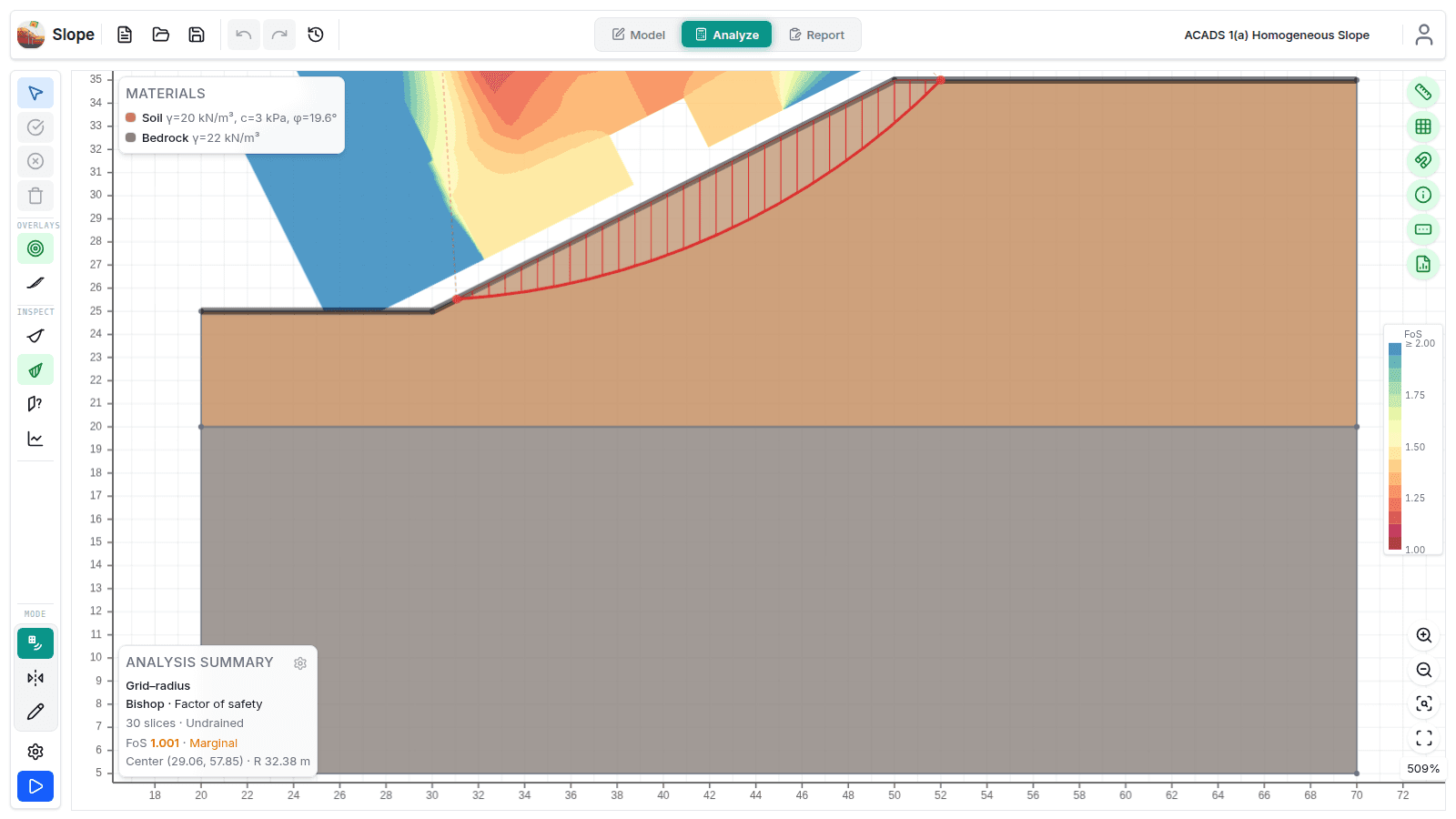
| ACADS 1(a)Simple homogeneous slope | 0.987 | 0.993 | 1.000 | −0.6% |
| ACADS 1(b)Tension crack | 1.594 | 1.664 | 1.65–1.70 | −4.2% |
| Arai & TagyoHomogeneous | 1.404 | 1.417 | 1.451 | −0.9% |
| ACADS 1(c)Non-homogeneous, 3-layer | 1.393 | 1.413 | 1.390 | −1.4% |
| ACADS 1(d)3-layer + seismic kₕ=0.15 | 1.005 | 1.016 | 1.000 | −1.1% |
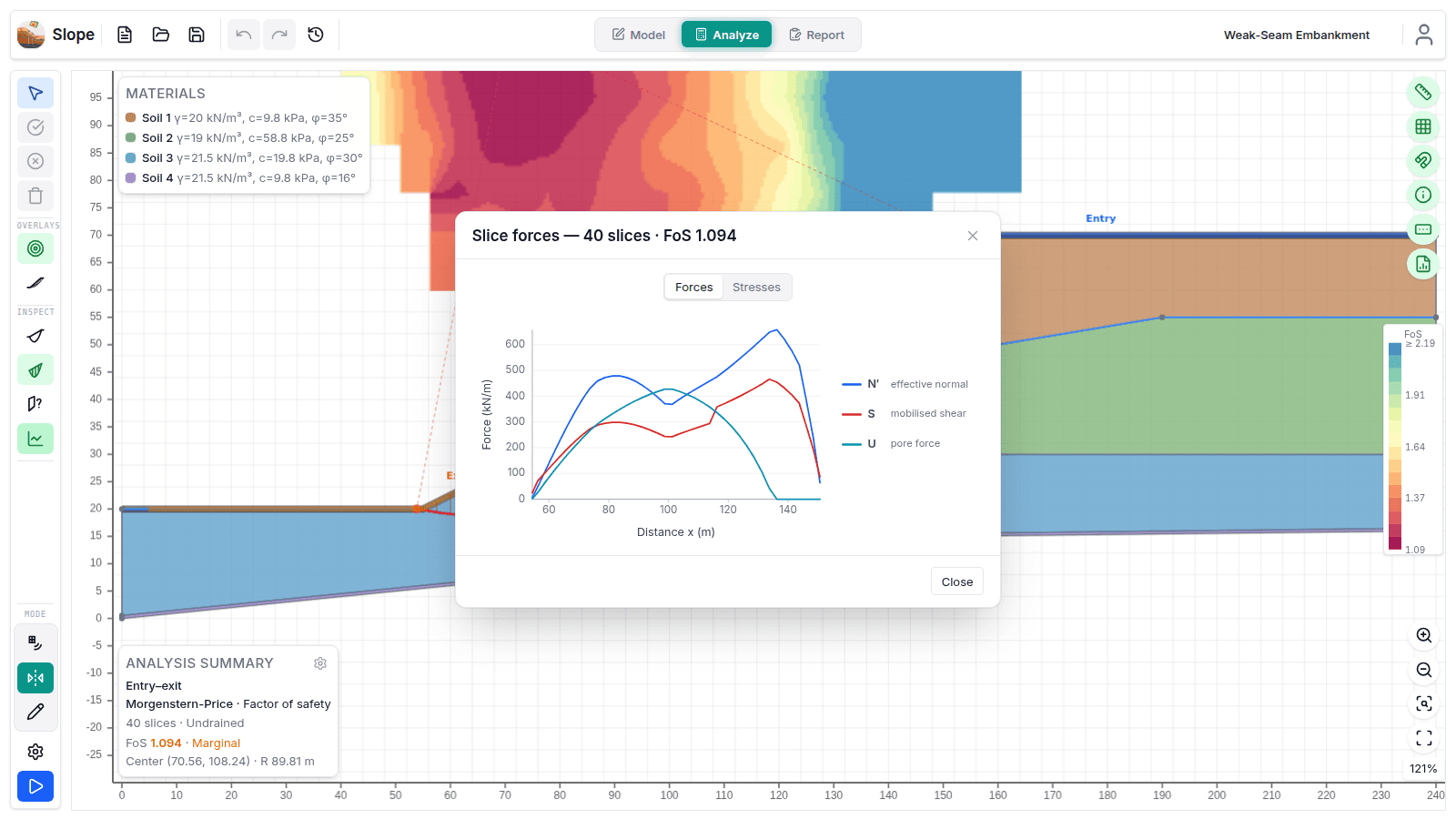
ACADS 1(b) is the one case where the two commercial manuals themselves disagree (SLOPE/W 1.664 vs Slide2 1.596, a 4.1% spread); our value matches Slide2’s to 0.5%. The suite’s non-circular weak-layer family is also replicated on Morgenstern–Price (Bishop is gated off polylines): the specified surface of ACADS 3(b) to −0.6%, the block-searched 3(a) to −4.8% (a search-landscape divergence where our two-window search finds a more critical, conservative block than GeoStudio’s), and §2.9’s external-loading case, the same dipping weak seam carrying a piezometric surface and a new linearly-varying (trapezoidal) surcharge, to +6.7%. Here the divergence runs the other way: GeoStudio’s manual restricted its search to circular surfaces (its own published Bishop, 0.692, sits on that same circular family), while our block search finds the seam’s true non-circular mechanism, matching the identical problem’s Slide2 publication (its own block-searched GLE value) to +2.1% (§ below).
Rocscience Slide2
53 verification cases
| Case | Slope (Bishop) | Slide2 | Reference | Δ |
|---|---|---|---|---|
| #1Homogeneous, dry (ACADS) | 0.987 | 0.987 | 1.000 | 0.0% |
| #2Water-filled tension crack | 1.588 | 1.596 | 1.650 | −0.5% |
| #3Non-homogeneous 3-layer (ACADS 1(c)) | 1.392 | 1.405 | 1.390 | −0.9% |
| #43-layer + seismic kₕ=0.15 (ACADS 1(d)) | 1.007 | 1.016 | 1.000 | −0.9% |
| #5Talbingo Dam, end of constr. | 1.966 | 1.948 | 1.950 | +0.9% |
| #14Arai & Tagyo homogeneous | 1.406 | 1.409 | 1.451 | −0.2% |
| #17Yamagami & Ueta | 1.342 | 1.344 | 1.348 | −0.2% |
| #204-material, weak seam | 1.085 | 1.087 | 1.080 | −0.1% |
| #23Depth-varying cᵤ 15→30 (Low 1989) | 1.136 | 1.192 | 1.14 (Low) | −4.7% |
| #243-layer undrained (Low 1989) | 1.438 | 1.439 | 1.440 | −0.1% |
| #52aZhu & Lee 4-material | 2.008 | 2.010 | 2.035 | −0.1% |
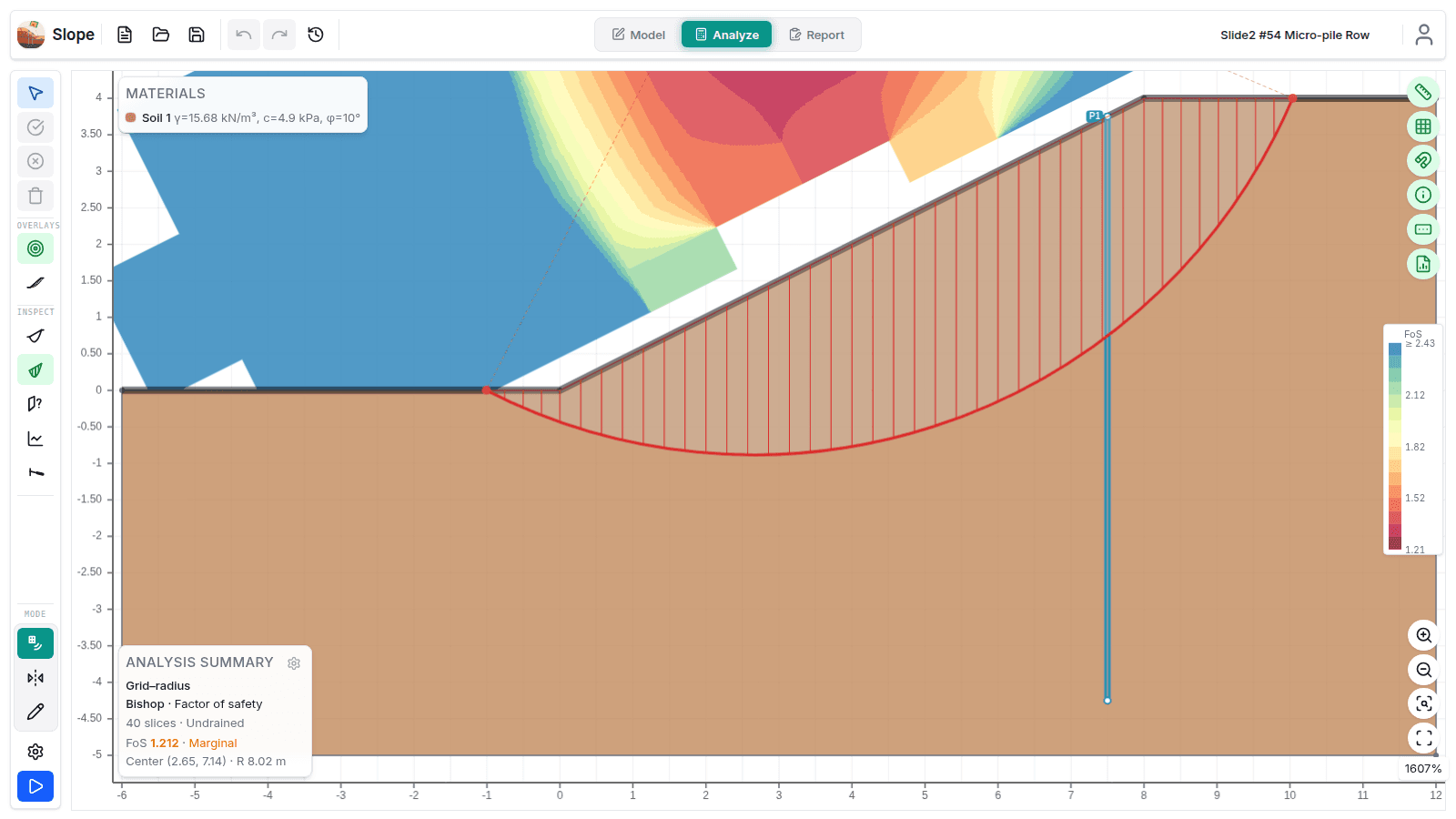
| #54rReinforced (micro-pile row) | 1.209 | 1.193 | 1.200 | +1.4% |
| #62bSeismic + rᵤ=0.5 pore pressure | 0.987 | 0.987 | 1.000 | 0.0% |
| #67USACE F-5 embankment | 1.324 | 1.332 | 1.330 | −0.6% |
| #75James Bay Dyke, 4 materials | 1.517 | 1.468 | 1.450 | +3.4% |
| #81Two-material embankment | 1.221 | 1.230 | 1.210 | −0.8% |
| #84Undrained foundation profile | 0.739 | 0.761 | 0.750 | −2.9% |
A representative 17 of the 53 replicated cases; the full set, including the reinforced micro-pile slope (§ below), the Baker Mohr-Coulomb envelopes and the six Duncan & Wright cohesive sub-cases, is in the PDF and shipped as machine-readable model files. #23’s Bishop is analyzed on the manual’s own tabulated critical circle; the published sources for that benchmark span 1.14–1.19, and our value matches Low’s original 1.14 to 0.4%.
Non-circular & composite surfaces
| Case | Slope (M-P) | Published GLE | Reference | Δ |
|---|---|---|---|---|
| #8Predefined weak-seam polyline (ACADS 3(b)) | 1.254 | 1.262 | 1.340 | −0.6% |
| #7Block search along the seam (ACADS 3(a)) | 1.200 | 1.275 | 1.24–1.27 | −5.9% |
| #9Weak layer + water table + trapezoidal surcharge (ACADS 4) | 0.735 | 0.720 | 0.780 | +2.1% |
| #22aComposite surface, dry (Fredlund & Krahn) | 1.392 | 1.372 | 1.370 (F&K) | +1.4% |
| #22bComposite surface, rᵤ = 0.25 | 1.139 | 1.114 | 1.118 (F&K) | +2.3% |
Slip surfaces beyond circles: the tabulated ACADS 3(b) polyline analyzed directly, the same problem block-searched (3(a) / #7, one of the campaign’s two primary comparisons beyond 5%, where our two-window search converges to a different, more critical block than the manual’s, the conservative direction for a search), the family’s fourth member (#9) adding a piezometric surface and a linearly-varying (trapezoidal) surcharge to the same dipping weak seam, matching Slide2’s published block-searched GLE to +2.1% (the companion GeoStudio §2.9 problem, on the same mechanism but a circular entry–exit search, is the campaign’s other exception beyond 5%, discussed above), and Fredlund & Krahn’s composite circular surface, the specified circle running along a thin weak seam, reconstructed as arcs joined by the weak-seam flat and analyzed dry and with rᵤ = 0.25. Bishop and Ordinary presume the common-center moment arm and are gated off polylines, so Morgenstern–Price carries the comparison.
Reinforcement
Anchors, nails, geogrids & piles
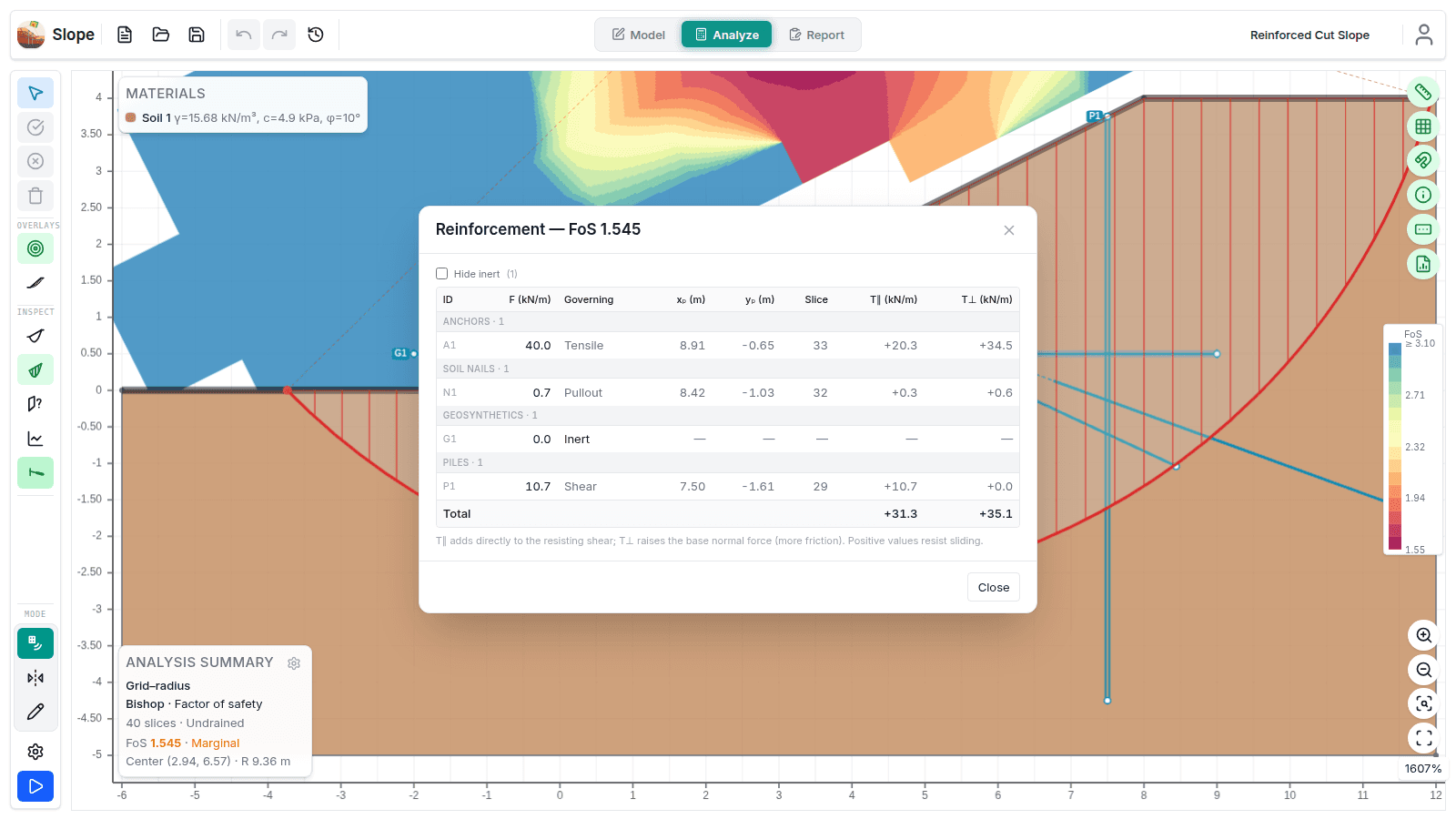
The engine models four reinforcement element types, each resolved at the slip-surface crossing into a base-tangential force T∥ (adds to the resisting shear) and a base-normal force T⊥ (raises the base normal force, and hence friction). Published circular reinforced benchmarks are scarce (the nailed and tied-back walls use planar surfaces, the geosynthetic embankments carry figure-only tension cracks), but the one fully-circular, tabulated case is reproduced: Slide2 #54, where a single row of stabilising micro-piles (1 m spacing, 10.7 kN lateral shear) lifts the factor of safety from an unreinforced 1.102 to Bishop 1.209 vs the published 1.193 (+1.4%).
| Element | Governing mode | F (kN/m) | T∥ | T⊥ | FoS |
|---|---|---|---|---|---|
| Grouted anchor | strip-through | 40.0 | +27.9 | +28.7 | 1.642 |
| Soil nail | tensile | 40.0 | +26.7 | +29.8 | 1.442 |
| Geosynthetic sheet | tensile | 30.0 | +29.1 | +7.3 | 1.427 |
| Pile (shear dowel) | shear | 10.7 | +10.7 | +0.0 | 1.217 |
Capability demonstration: each element type applied to the #54 slope on its unreinforced critical circle (Bishop ≈ 1.100), compared on identical geometry. Illustrative of the force resolution, not a published-benchmark comparison.
Inside the application
From model to result
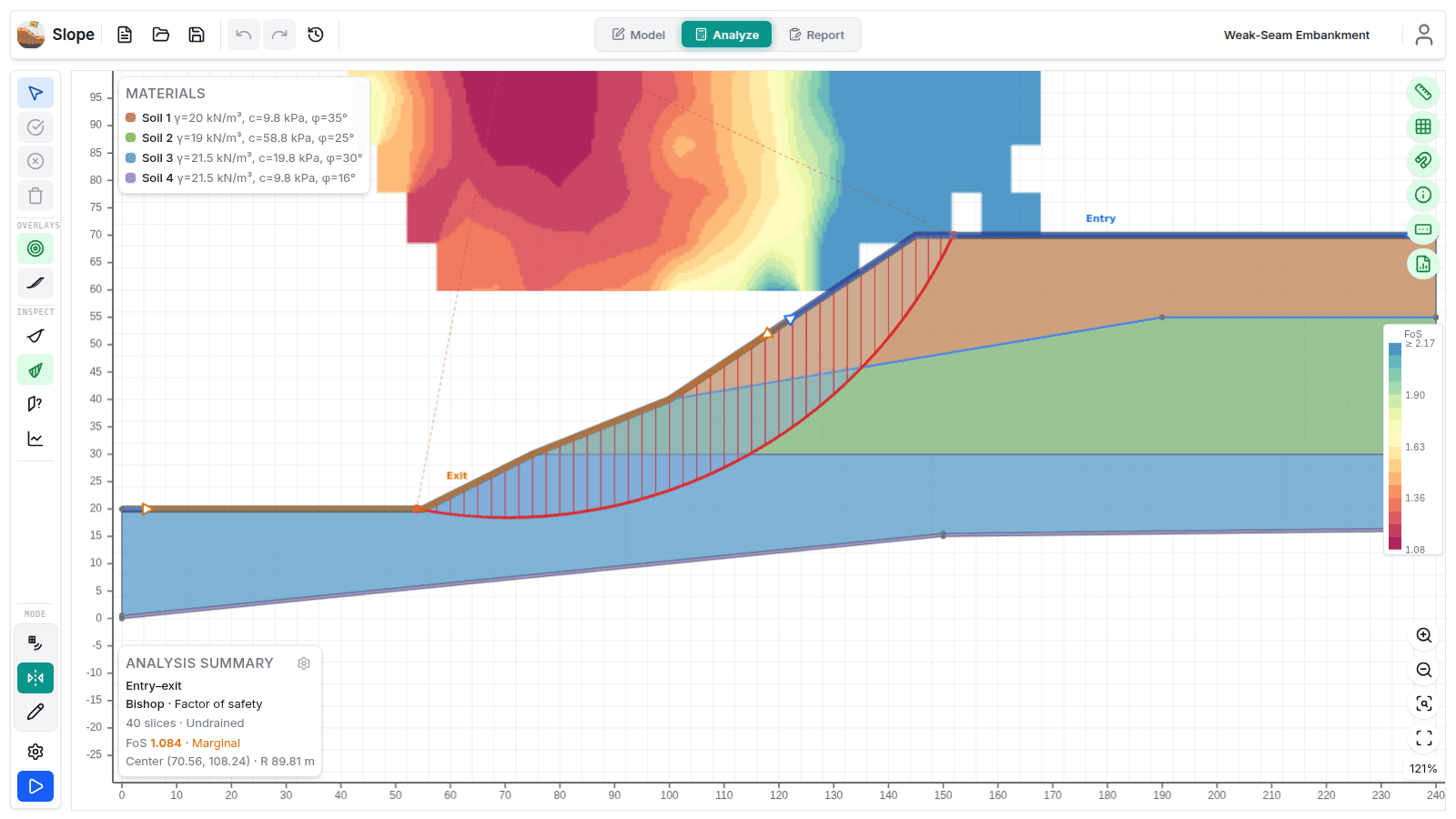
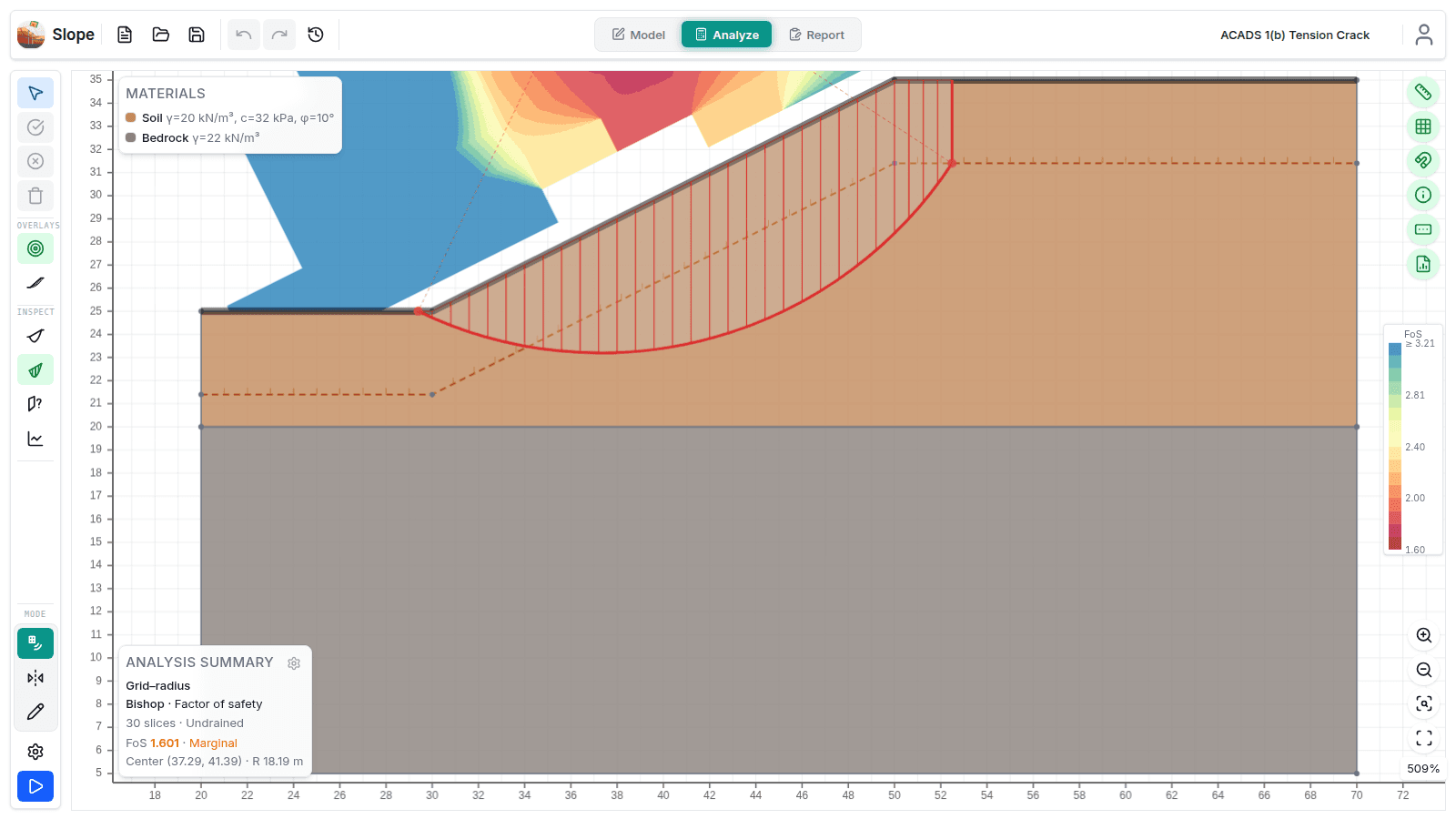
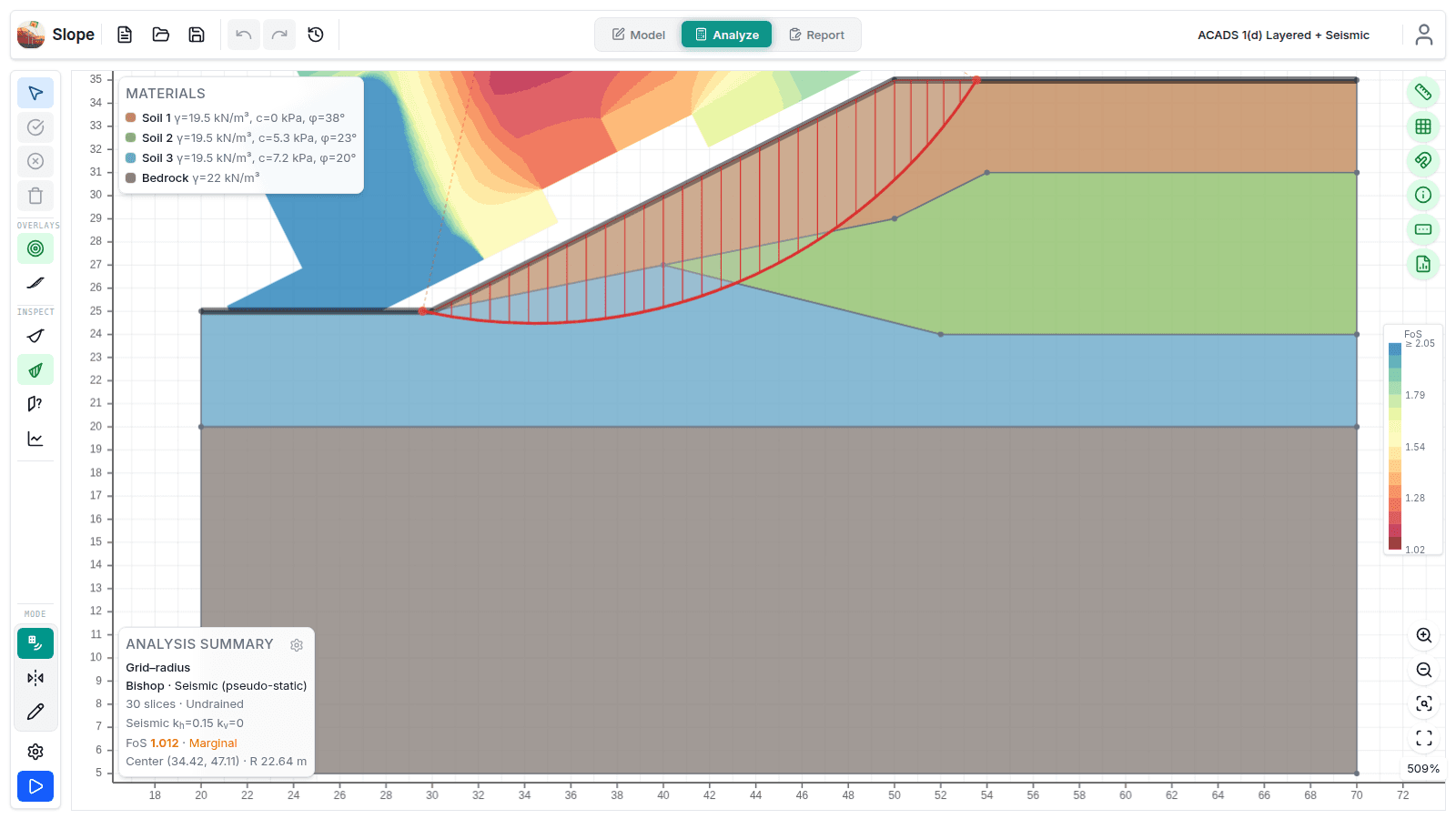
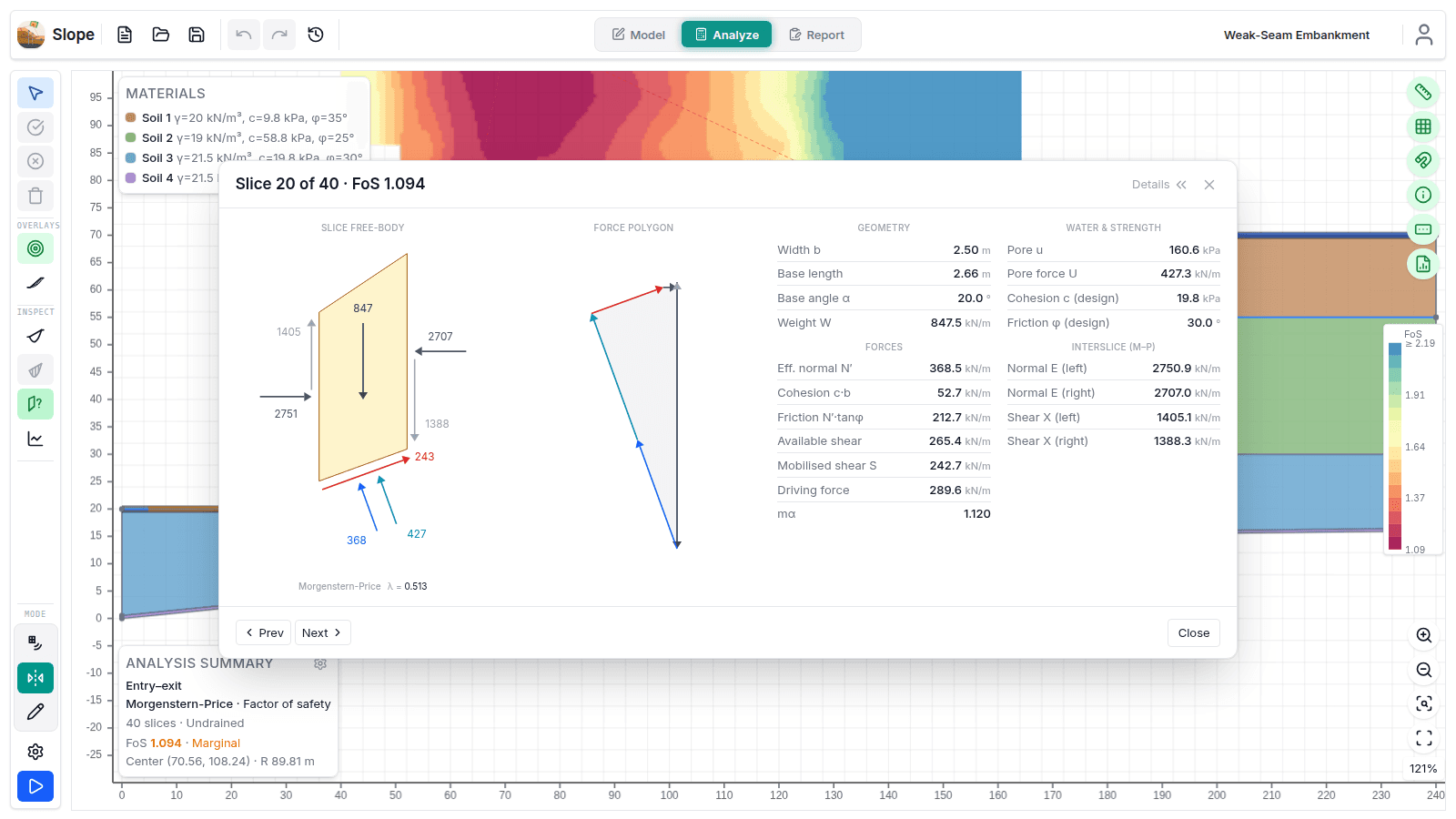
Read the full whitepaper
Complete methodology, all 61 cases, independence checks and references (24 pages).
Benchmarks reproduced from the GeoStudio SLOPE/W and Rocscience Slide2 verification manuals for independent validation; all trademarks belong to their respective owners.